

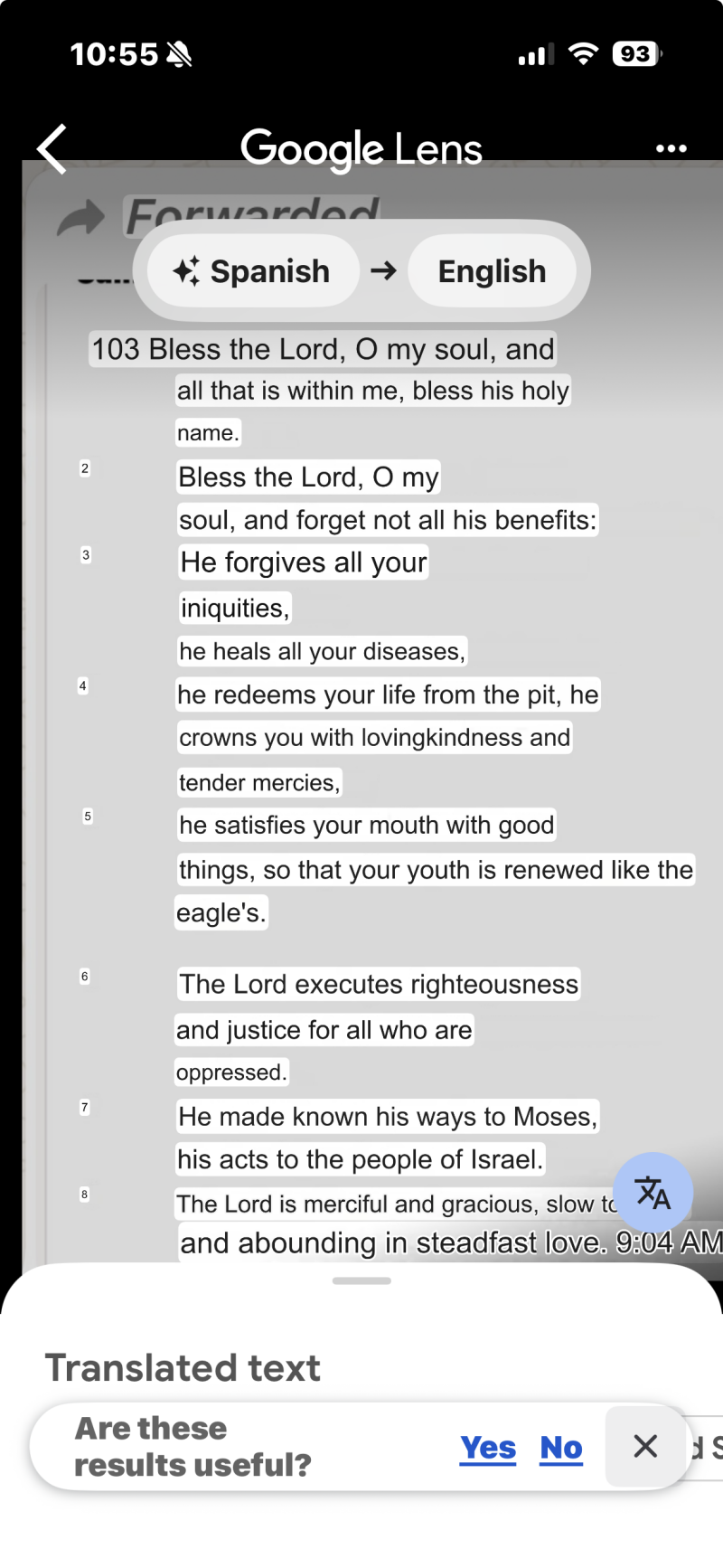
This image shows part of Psalm 103, translated from Spanish to English using Google Lens because it was sent to me by someone who speaks another language. I love that others in my life can send these to me, and I can use the lens to translate the text.
The passage visible is primarily verses 1–8.
The central themes of this Psalm are:
Remembering God’s goodness,
Forgiveness and healing,
Redemption from suffering,
Mercy and compassion,
God’s steadfast love toward His people
A few especially meaningful lines shown are:
“Bless the Lord, O my soul, and forget not all his benefits”
and
“He forgives all your iniquities, he heals all your diseases”
and
“The Lord is merciful and gracious, slow to anger and abounding in steadfast love.”
This Psalm is often used:
during illness or hardship,
in prayers of gratitude,
for encouragement during emotional exhaustion,
and as a reminder not to forget what God has done.
The wording appears close to translations such as the English Standard Version or the King James Version, with slight variations from Google Lens.
There’s also something significant about the structure of the Psalm: David speaks to his own soul. He is intentionally reminding himself of the truth when emotions or circumstances could make him forget. That is a very biblical pattern of faith:
preach truth to yourself,
remember God’s character,
and anchor your heart in what He has already done.
For someone walking through uncertainty, health struggles, emotional fatigue, or spiritual discouragement, Psalm 103 is often deeply comforting because it focuses less on human strength and more on God’s mercy.
“Bless the Lord, O My Soul”
Understanding Psalm 103 Through Biblical Translation and Everyday Life
There are some passages in Scripture that feel like a deep breath for the soul. Psalm 103 is one of them.
When we read Psalm 103, we are not simply reading poetry or encouragement. We are reading a personal declaration from David — a man who knew failure, grief, victory, fear, repentance, and restoration. In this Psalm, David speaks directly to himself:
“Bless the Lord, O my soul, and all that is within me, bless His holy name.”
This is more than emotional worship. It is intentional remembrance.
David is teaching us something important: sometimes faith means reminding our own soul who God is before our feelings catch up.
The Importance of Biblical Translation
The screenshot translation above shows this passage in English after it was translated from Spanish using Google Lens. While modern tools help us access Scripture quickly, studying biblical translations can deepen our understanding of what God is saying.
The Old Testament, including Psalm 103, was originally written mostly in Hebrew. Hebrew is rich with layered meaning, emotion, and imagery. Sometimes, one English word cannot fully capture the depth of the original language.
For example:
“Bless the Lord”
The Hebrew word often translated as “bless” here is barak.
This does not mean we somehow make God greater. God is already perfect. Instead, it means:
- to kneel in reverence,
- to praise,
- to adore with humility,
- and to acknowledge God’s greatness.
David is calling his entire being into worship.
Not just his mouth.
Not just church attendance.
Not just outward behavior.
“All that is within me.”
This includes:
- thoughts,
- emotions,
- fears,
- memories,
- desires,
- and even wounded places.
True worship involves the whole heart.
“Forget Not All His Benefits”
One of the most powerful lines in Psalm 103 is:
“Bless the Lord, O my soul, and forget not all His benefits.”
The biblical idea of “forgetting” is not merely losing memory. In Scripture, forgetting often means living as though God has not been faithful.
We still do this today.
We forget:
- Prayers God answered,
- doors He opened,
- protection He gave,
- Healing he brought
- Forgiveness, He offered,
- And grace He showed us in seasons we barely survived.
David understands how quickly human beings drift into discouragement when we stop remembering God’s goodness.
This Psalm becomes a spiritual discipline of remembrance.

God’s Benefits According to Psalm 103
David begins listing the goodness of God:
He Forgives
“He forgives all your iniquities.”
The Hebrew understanding of forgiveness is not shallow approval of sin. It is the lifting away of guilt and separation.
God does not pretend sin is harmless.
He redeems us from it.
Many people carry shame long after God has offered forgiveness. Psalm 103 reminds believers that God’s mercy is bigger than our failures.
Applying this to life means:
- accepting repentance seriously,
- receiving grace honestly,
- and refusing to live chained to what Christ already paid for.
He Heals
“He heals all your diseases.”
This verse has been discussed deeply across many biblical traditions. Some understand this as physical healing, others spiritual healing, and many believe it includes both.
Biblically, healing is not always instant, but God is always present in suffering.
Sometimes He heals:
- physically,
- emotionally,
- mentally,
- relationally,
- or spiritually.
Even when healing comes slowly, Scripture repeatedly shows God caring deeply about human pain.
Application for life:
- bring wounds to God honestly,
- pray boldly,
- but also trust Him even in seasons of waiting.
Faith is not pretending pain does not exist.
Faith is believing God remains good within it.
He Redeems
“He redeems your life from the pit.”
The word “redeem” carries the idea of rescue, restoration, and buying back something valuable.
The “pit” in biblical language often symbolized:
- despair,
- destruction,
- death,
- hopelessness,
- or separation from God.
Many people know what it feels like to live emotionally or spiritually “in a pit.”
Psalm 103 reminds us:
God specializes in rescue.
No life is too broken.
No story is too damaged.
No failure is beyond God’s reach.
He Crowns You with Love and Mercy
This is one of the most beautiful reversals in Scripture.
Human beings often crown themselves with:
- pride,
- status,
- appearance,
- accomplishments,
- or worldly validation.
But God crowns His children differently:
with lovingkindness and tender mercy.
The Hebrew word for lovingkindness here is often connected to hesed — God’s covenant love:
- faithful,
- enduring,
- compassionate,
- and undeserved.
This means our identity is not meant to rest in worldly approval but in God’s faithful love.

“The Lord Is Merciful and Gracious”
Verse 8 says:
“The Lord is merciful and gracious, slow to anger and abounding in steadfast love.”
This statement appears throughout Scripture because it reflects the very character of God.
God is:
- holy,
- just,
- righteous,
- but also patient and compassionate.
Many people struggle with viewing God only through fear or punishment. Psalm 103 balances truth with mercy.
Biblical Christianity is not built on pretending sin does not matter.
It is built on the reality that God’s mercy meets us in our need for redemption.
Applying Psalm 103 to Everyday Life
Psalm 103 is not meant to remain beautiful words on a page. It teaches us how to live.
1. Speak Truth to Your Soul
David talks to himself spiritually.
In modern life, many voices compete for our attention:
- anxiety,
- shame,
- social pressure,
- fear,
- bitterness,
- disappointment,
- and comparison.
Psalm 103 teaches believers to answer those voices with truth.
Sometimes spiritual maturity looks like saying:
“Soul, remember who God is.”
2. Practice Gratitude Intentionally
“Forget not His benefits.”
Gratitude is not denial of hardship.
It is recognition of God’s faithfulness within hardship.
Keeping track of God’s goodness changes perspective over time.
3. Trust God’s Character During Uncertainty
Circumstances change.
Feelings fluctuate.
People disappoint us.
But Psalm 103 anchors faith in the unchanging nature of God.
He is:
- merciful,
- gracious,
- patient,
- loving,
- forgiving,
- and faithful.
4. Let Worship Become Personal
David says:
“All that is within me.”
Biblical worship is not performance.
It is surrender.
It means bringing:
- joy,
- pain,
- confusion,
- gratitude,
- weakness,
- and hope before God honestly.
Psalm 103 is ultimately an invitation to remember.
Remember:
- who God is,
- what He has done,
- how He forgives,
- how He restores,
- and how deeply He loves His people.
In a world that constantly teaches people to place identity in achievement, appearance, success, or approval, Psalm 103 redirects the heart back to God’s mercy.
David understood something many believers still need today:
When life becomes overwhelming, sometimes the soul needs to be reminded before it can rejoice again.
And so we say with him:
“Bless the Lord, O my soul, and all that is within me, bless His holy name.”


Add comment
Comments